You did the work.
Now build the case.
Quota is the part everyone already knows. ClarixECP is where the rest lives — the pipeline you sourced, the executives who back you, and a straight read on what your next level requires.
By review season the case is already written, from what you actually did.
Free. Two fields to start, and no payment details.
“Not this cycle.” And nobody could tell you what would have been enough.
You are told to keep doing what you are doing. To show more executive presence. That it was close. None of that tells you which of the things you did this year counted, what is still missing, or whether the gap is something you cannot yet do — or something you have simply never been given the chance to do. Those two are indistinguishable in a review and need opposite answers: one needs coaching, the other needs a different project. Guess wrong and you spend a year working on the wrong thing.
The vagueness is a documented failure of review processes, not a personal one. Stanford researchers found that feedback is systematically less likely to be tied to a specific outcome when it is written about a woman — by male and female managers alike — which makes it useless both for fixing a weakness and for being promoted on work already done. Correll & Simard, Harvard Business Review, 2016
ClarixECP tells them apart, and keeps the receipts. You log the evidence as it happens — business originated, thought leadership published, executive sponsors, certifications — against targets and weights you set yourself. You assess yourself, skill by skill, against a matrix that names what your level and the next one expect. And a coach sits across both, reading your live records before it says anything, and updating them for you once you confirm the change.
Three parts. You only ever feed one.
Log the work once. The score, the diagnosis and the coach all read the same records — there is no second system to keep up to date, and nothing to reconstruct the week before a review.
A tracker
Four pillars of evidence, each with your own target and weight, rolled into one score that moves because you did something real — not because you ticked a box.
A career framework
The bar for your level and the one above it, written out skill by skill, so “not ready yet” turns into a list of named gaps instead of a feeling.
A coach that reads and writes both
An executive coach with your live record already in front of it — and one that logs the update for you, so keeping the tracker current is a sentence, not a chore.
What it looks like with something in it
These are the actual screens, not mockups. What is in them is not: every account below was created to demonstrate the product, and everything in it is made up.
Everything shown here is fictional. Claire Jones, Dan River and Rachel Hammand are invented people in demonstration accounts built for development and testing. The employers, clients, colleagues, revenue figures, assessments and quotations beside them were written to fill those accounts and describe nobody. No customer record appears in any image on this site, and none of these accounts belongs to a real person.
Your own workspace is private to you.
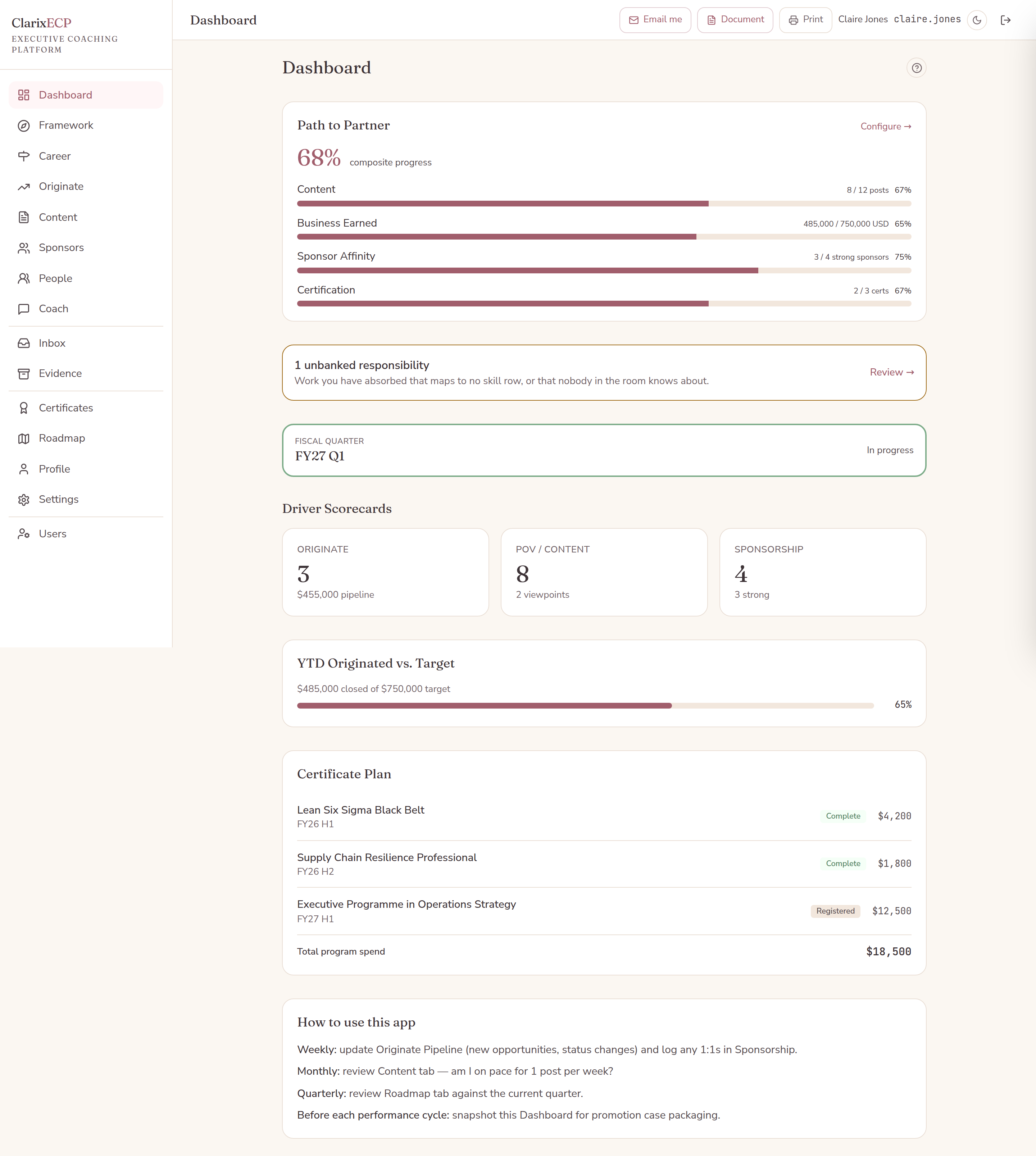
The tracker
Four pillars, each with a target and a weight you set, rolled into one score that moves when you log something real.
Demonstration account — fictional data
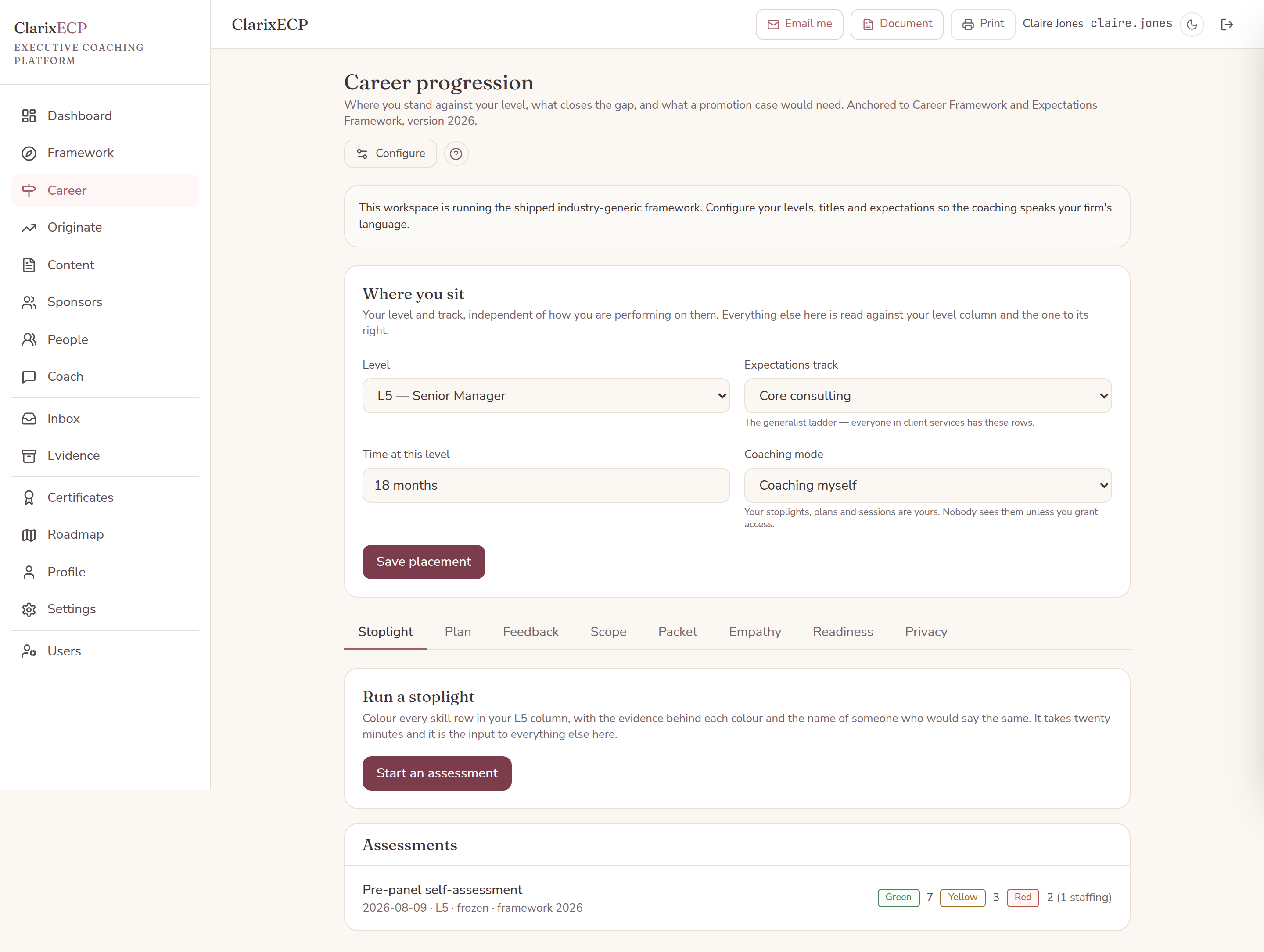
The diagnosis
Your level column, assessed skill by skill — and a red split into the thing you cannot yet do and the thing you have never been given.
Demonstration account — fictional data
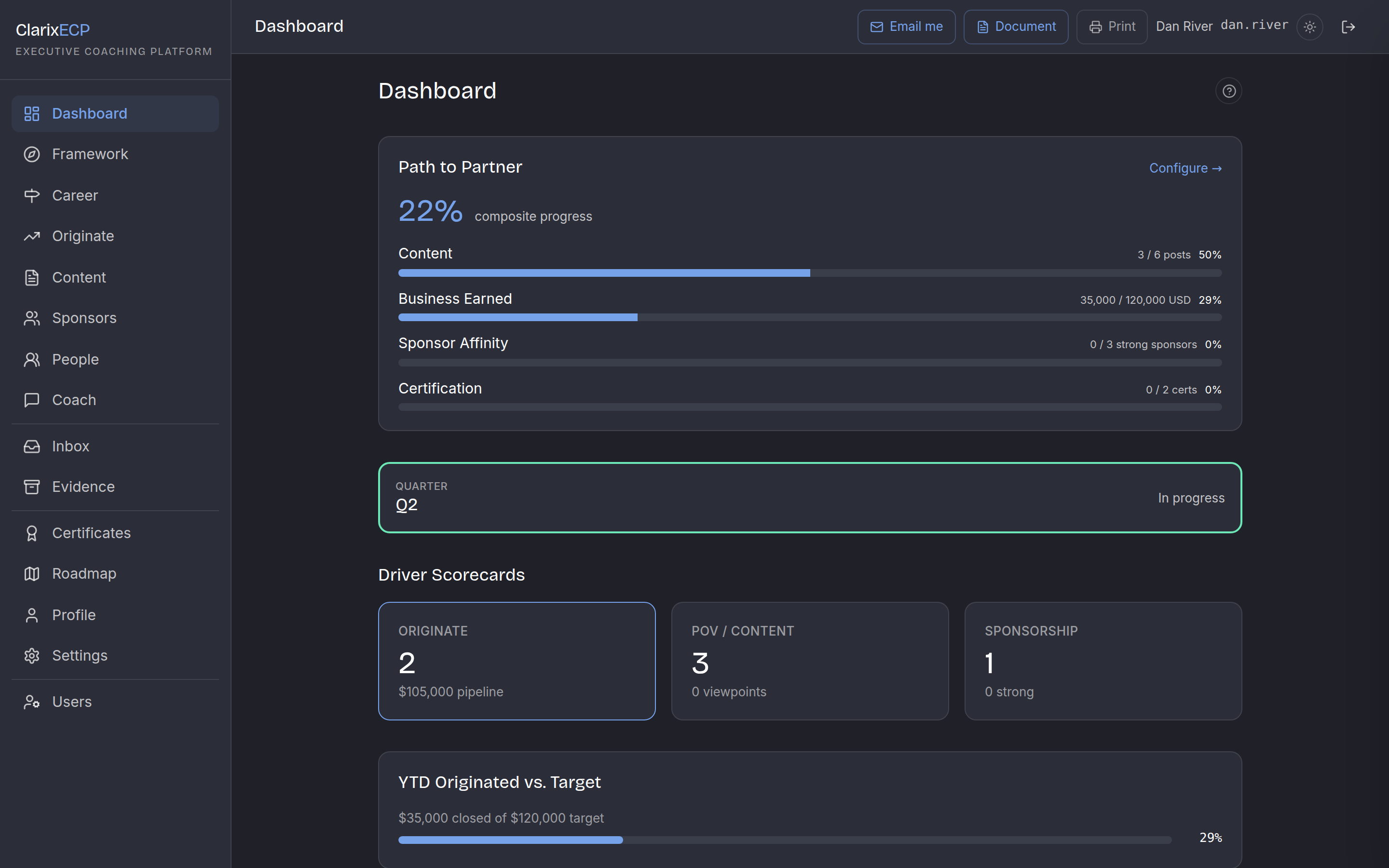
Five themes, light and dark
Pick the look once. Every screen follows, on every device you sign in from.
Demonstration account — fictional data
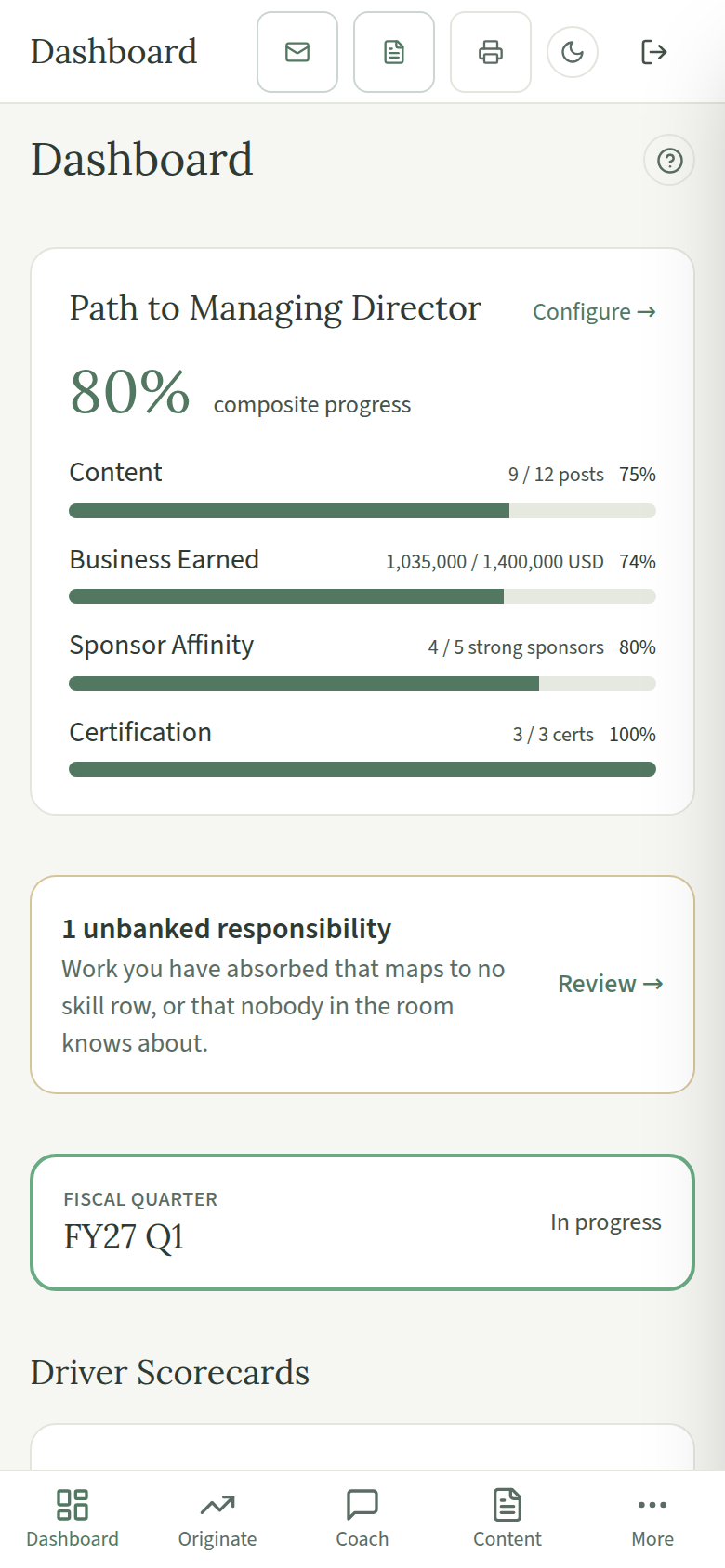
On the phone it happened on
Log the win on the walk back from the meeting, not on Friday from memory.
Demonstration account — fictional data
Your account starts empty and fills up with your own work.
The four kinds of evidence that get people promoted
Each pillar has its own screen, its own target, and its own weight in the composite score. Change any of them — or add a pillar of your own — from the framework screen.
Pipeline
The deals you sourced and closed — account, stage, value, and the executive sponsor behind each one. Quota is the floor; this is the record above it.
Content
Your point-of-view calendar — type, theme, channel, target date, and the engagement each piece came out of.
Sponsors
The executives who will advocate for you — relationship strength, contact cadence, what you owe them next, and what they actually care about.
Certifications
Credentials in flight and earned — provider, status, course window, cost, rationale, and the certificate file itself.
An hour to set up. Minutes a week after that.
The work is logging what already happened, not filling in a system.
Set up
An email and a password is all it takes to begin. A short wizard asks where you work and the roles you are moving between, then hands you to the coach — which interviews you and proposes your starting targets, so you never face an empty screen.
Track
A deal you sourced yourself, a webinar you fronted, a VP who agreed to back you — log it in a sentence, the week it happens. The composite score follows your data, not a checklist.
Diagnose
Run a stoplight assessment against your level column to see, skill by skill, what is green, what is inconsistent, and what you have simply never been given the chance to do.
Plan
Turn the diagnosis into a bounded development plan and a promotion case, then check back against it every quarter.
Find out where you actually stand
The tracker shows what you have done. The career module answers the harder question — what your level expects, where the gap is, and whether the gap is capability or opportunity.
That last distinction is the whole point. Decades of leadership research — the Center for Creative Leadership’s work on how managers actually develop — puts challenging assignments, not training, at the centre of it. A skill you were never assigned to is an assignment problem, and no amount of coaching closes it. McCall, Lombardo & Morrison, The Lessons of Experience
Level placement
Set your track and level. The expectations matrix ships with defaults for every skill at every level, and an administrator can override any cell to match how your organization actually writes the bar.
Stoplight assessment
Colour every skill row red, yellow, or green against your level — with the distinction that matters: a red you cannot yet do, and a red you have never had the chance to do. The first needs coaching; the second needs staffing. Past runs are kept so you can see what moved.
Development plan
Two or three focus areas, each anchored to a named skill and level, with target behaviors, the engagement where you will practice them, and checkpoint dates.
Promotion readiness
Read against the next level’s column rather than your own: sustained performance, demonstrated reach, corroboration, and any evidence gaps still open.
Empathy as a hard skill
Empathy is assessed like any other skill row — at a level, with evidence — on the view that reading unarticulated needs is what makes scope, leadership, and commercial growth possible.
Yours alone
Assessments, plans, and pasted feedback are private to you by default, with their own privacy panel and their own export. Nothing in this module is visible to your organization unless you share it.
A coach that has already read your file
One coach, two modes: coaching yourself, or preparing to coach someone who reports to you. Give it a name and a style; it keeps every session and picks up where you left off.
It reads your data first
Before every reply the coach assembles a live snapshot — pillar scores, opportunities, sponsors, content, certificates, roadmap, and your career records. You control what it may see, per data type.
It writes the tracker, not just about it
Say a post went live or a deal moved to proposal, and the coach records it — creating and updating sponsors, content, opportunities, certificates, quarters and career records, and removing one only when you ask it to. Every action it takes is shown alongside its reply, and everything it touches stays editable on the normal screens. It cannot reach your account, your workspace, or anyone else’s data.
It proposes; you decide
A new workspace starts empty on purpose. The coach interviews you and proposes a starting set of pillar targets and weights — and proposals are the one thing it cannot apply itself. They sit in the thread until you press Apply or Dismiss. Research permissions work the same way.
It knows the ground you are standing on
With your consent, and only for the scopes you switch on, it can also draw on your company’s market and competitors, your own public background, and the industry landscape. Revoke a scope and it is gone from the next message.
It gives you the plan in writing
Generate a structured 30/60/90-day plan from the conversation, then email the transcript to yourself or print it to PDF for a review meeting.
It is honest about being a model
The coach runs on Amazon Nova Pro via AWS Bedrock. It prepares your case; it does not make promotion, rating, or compensation decisions, and it says so.
Everything else, included
Framework & composite score
Configurable pillar weights, targets, and data sources. Add your own pillars, retire the ones that do not apply, or enter progress manually where no table fits.
24-month roadmap
Quarter-by-quarter milestones with themes, driver actions, and status — aligned to your fiscal calendar, not the calendar year.
Company & department
Say where you work, pick a company your colleagues have already added, and record moves as your career changes. Company fact sheets carry market, offerings, and competitors.
Profile & people directory
An opt-in directory with independent visibility switches — share with your organization, your manager chain, or named sponsors. Every one of them is off until you turn it on.
Email it to yourself
Send a dashboard snapshot or a coaching transcript to your own registered address, then forward or archive it. The app will not send your data to anyone else.
Print to PDF
Print-styled dashboard and coach transcript, produced by your own browser. No server-side rendering of your data, no third-party document service.
Notifications you control
An optional weekly progress digest, plus the account mail you asked for. Per-type preferences, a confirmed address required, and one-click unsubscribe on every digest.
Workspaces & admin
Workspaces with owner, admin, and member roles, and the ability to belong to several and switch between them. Administrators get user management and an editor for the expectations matrix; company administrators approve who joins their company.
Light and dark
A full dark theme that follows your system preference until you override it — on every screen, including this one.
Help where you are
A contextual help drawer on every page, a master user guide covering the scoring maths and each feature, plus an FAQ and changelog you can read before you sign up.
You are writing down client names. Here is exactly where they go.
The app asks you for deal values and a candid read on which colleagues will advocate for you. That earns a straight answer about where it is kept, what the AI is shown, and how you leave with all of it.
Scoped to you, row by row
Every record carries the workspace and the user who owns it, and every API route filters on both. Sign-in and password endpoints are rate limited. Passwords are hashed with scrypt; sessions are opaque server-side tokens in httpOnly cookies.
Take it all with you
One request returns a complete JSON export of everything you own — tracker, career records, and coaching transcripts included.
Leaving is a supported path
Close your account and it goes read-only for 30 days, locks for 30 more, then is deleted — reversible at any point in that window. Or delete it outright today; that one is not reversible, and we say so before you confirm.
What the AI is told
The coach sees the data types you leave switched on, plus the research scopes you consent to. It is a language model producing advice, not an authority on your promotion — the Privacy page sets out exactly what is sent and to whom.
Read the full Privacy Policy, Terms, the FAQ, the research this is built on, or what shipped recently in the changelog.
Your next review is already being written.
Start the record now, while you can still remember what you did this quarter.
Start building my caseAn email and a password is the whole form. Free, with no payment details now or anywhere later in the flow.